Cloud Platform
Nimbus Cloud OS
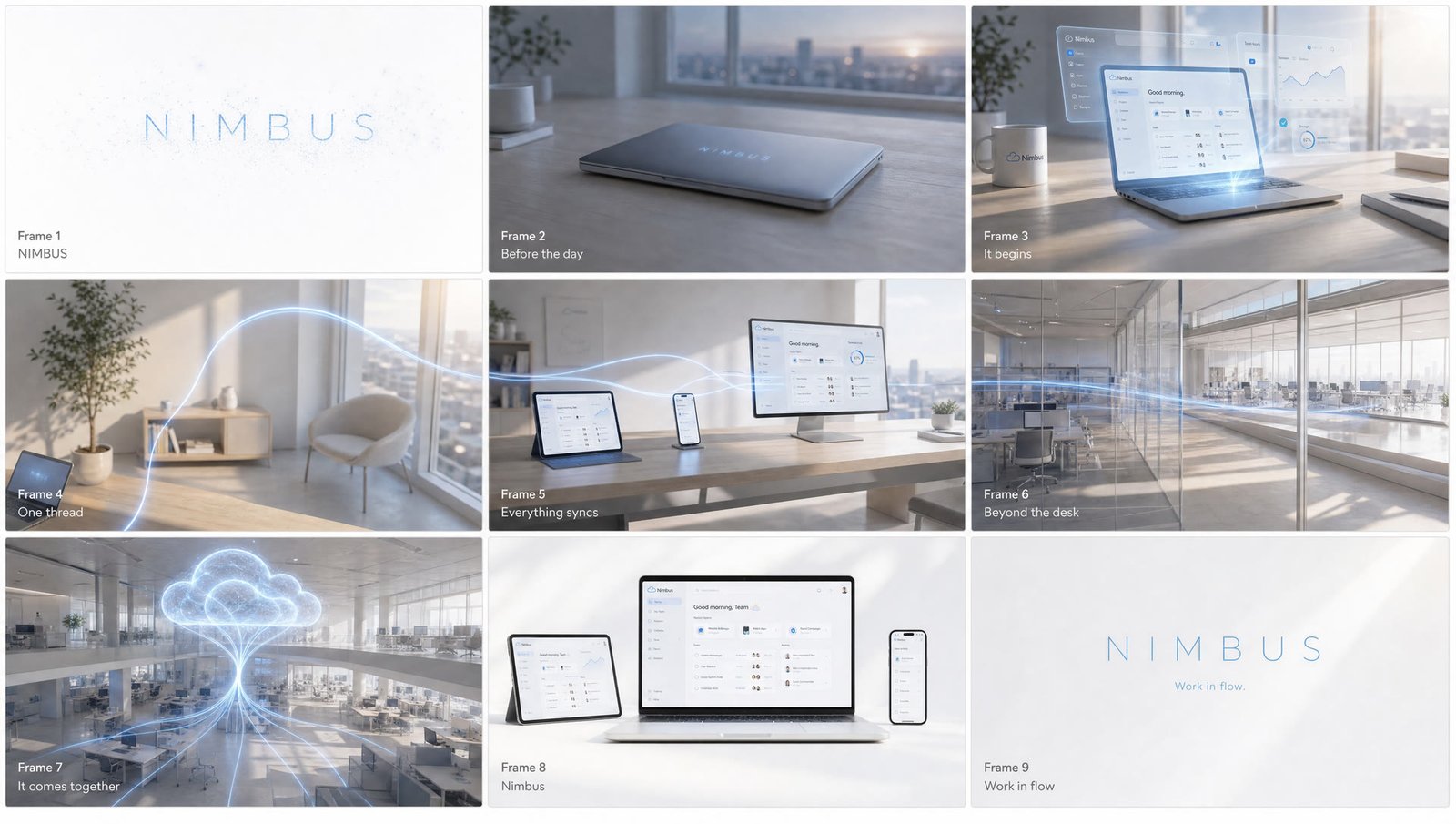
Thirty seconds of architectural software motion for a cloud workspace platform — treating the digital interface as a physical, dimensional sculpture.
The Digital Abstraction Problem
Hardware can be lit from an angle. Cars and watches possess physical mass and tactile curvature. Software, on the other hand, lives on flat glass screens with neither physical weight nor volume. Most software marketing attempts to bridge this by showing actors typing in coffee shops — turning the narrative into a story about real estate rather than the product itself.
Nimbus took the architectural route: transform the user interface itself into a dimensional, kinetic physical object. UI containers have real glass thickness, cast soft ambient occlusion shadows, and orchestrate into 3D space with tangible weight.
Spatial Depth & Refraction Passes
The interface elements were separated into distinct spatial layers in 3D space. Glassmorphic frosted panels utilize real-time transmission shaders with subtle index-of-refraction distortion. As the camera glides across data cards and navigation rails, elements beneath the frosted glass blur dynamically.
Lighting was kept strictly monochromatic with a singular warm amber accent identifying key interactive touchpoints, preventing the user interface from appearing like a confusing kaleidoscope.
Vector Typography Compositing
AI-generated renders frequently struggle with exact corporate typography and crisp wordmark kerning. To maintain enterprise-grade rigor, all button labels, data tables, and closing logo lockups were composited in post-production using raw SVG vector paths frame-locked to the 3D camera tracker.
Pre-Production & Keyframes
Approved Storyboard & Stills
Interface Breakdown